How to child-proof your home’s electrics?
As the old cliché goes, parenting doesn’t come with a manual.
There are so many things to manage and keep track of; not least of all shielding your little ones from potential injury and serious harm.
Even before they start to crawl, small children can get themselves into all sorts of unexpected mischief. It’s essential to ensure your home is fully baby-proof and toddler-proof before you bring them home; especially when it comes to your home’s electricity.
Here’s our quick and handy guide on how to child-proof your home’s electrics.
Keep cables out of sight
Loose cables can not only become a potential strangulation or shock hazard for young kids, but if they’re left to mess with them, they can become a nasty trip hazard for parents too!
Use cable tidy units and strips to keep wires tucked away at the perimeter of your rooms.
And when it comes to unconnected cables like phone and laptop charges, ensure that these are unplugged and stored away when not in use. After all, how many times do you have to tell toddlers to not put things in their mouth?



DON’T use plug socket cover inserts
As we pointed out in our article about unsafe electrical products you should always avoid, plug socket cover inserts might seem like a good idea; but they can quickly turn a perfectly safe socket into a serious hazard.
That’s because these products are not currently regulated, and it’s surprisingly easy to find inserts with any number of the following flaws:
- They’re too big to safely fit the socket, creating potential fire and/or shock hazards.
- Their design still enables children to remove them, or to jam objects between the cover pins and the socket.
- Their design allows the shutters inside the socket to be jammed open; exposing the live contacts instead of concealing them.
- They’re more eyecatching and appealing to children, which means they’re more likely to mess around with them.
Modern plug sockets in the UK are built with shutters inside, which automatically and safely block the contacts from anything that isn’t a plug. Plus, the pin holes themselves are simply too small for your children’s fingers to reach inside to the live metal.
If you’re still worried, consider investing in lockable socket protector cases instead. These don’t plug into the socket pin holes, but instead cover the entire face of the socket.
You can even find ones with enough room for plugs inside; enabling you to keep appliances plugged in without compromising your children’s safety.
Pay attention to particular rooms
Kitchen, bathroom, laundry and garage areas can be some of the most dangerous rooms in the home for children. Many of the appliances used in these rooms can present a risk of cuts, burns, fire and shocks.
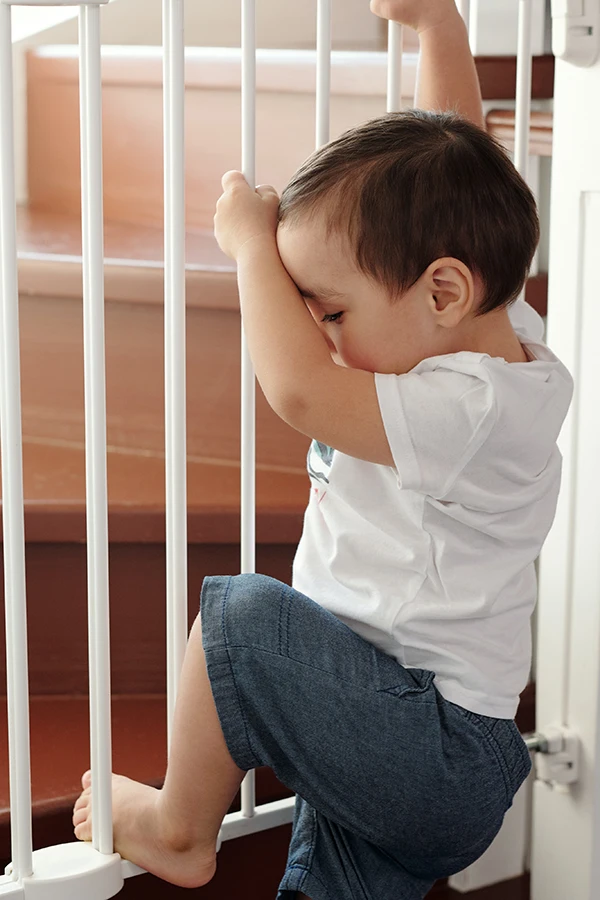
For the latter three rooms, it’s a good idea to lock out small children entirely with safety gates; but there’s always the chance they’ll still get in if you accidentally leave the gate unlocked.
That’s why it’s important to take additional precautions, including:
- Keeping any handheld and worktop appliances (such as kettles, microwaves, shavers, hair straighteners, irons, and especially power tools) unplugged and away from reach in high cupboards with safety locks.
- Installing dial covers on ovens, washing machines and other white goods appliances.
- When cooking, make sure any saucepan handles aren’t sticking out over the edge where your children can grab at them; keep the handles turned in and facing the wall. It’s best to stick to the back hob rings if you can.
- Be vigilant when bringing food in and out of the oven. If your children pop up behind you unexpectedly, it’s easy to accidentally touch them with a hot baking tray.
Check cables for damage
While you’re tidying away cables, inspect them for any signs of damage. Wires can get crushed under furniture, torn by sharp objects, stretched too far across rooms, and/or scratched and frayed by your pets.
Any of those problems present in high-voltage cables can cause dangerous overheating or even expose live wiring, which are serious dangers for your entire household.
Be sure to replace any appliances with damaged cables. It’s better to avoid using electrical tape to fix high-voltage cables; we’d generally only recommend using electrical tape on low-voltage items like doorbells and thermostats.
Don’t let water and electricity mix
With the toasty summer we’re currently enjoying, you might already be blowing up the paddling pool for an afternoon of splishing and splashing in the garden with your little ones.
But when it’s time to go back inside, make sure your kids are fully dry before they start interacting with the appliances and fittings in your home. That goes for bath time, too.
Plus, you should ensure drinks are kept well away from electrical items, and that kitchen and bathroom appliances are kept away from sinks and baths (although as we’ve already covered, these should already be unplugged and locked up anyway).
Know what to do in an emergency
Even the most prepared parents can find themselves caught out by their childrens’ antics; so if the worst should happen, make sure you know what to do.
Familiarise yourself with your consumer unit (aka fuse box) and identify how to cut power to your home quickly in an emergency. Keep a fire extinguisher handy in case of a fire outbreak (although again, make sure it’s out of reach of children).
Make sure your kids know what to do in an emergency, too. Teach them how to call emergency contacts, and how to call 999 (but be sure to stress that the latter must only be called in a real emergency).
Be aware of non-electrical hazards
Of course, electricity isn’t the only potential hazard in your home. You should also take steps to insulate your home against other nasty hazards, including (but not limited to):
- Pointy corners and edges
- Slippery surfaces and trip hazards
- Wobbly or unsecure objects (particularly heavy ones)
- Poisonous substances and other dangerous-to-swallow items (such as watch batteries)
- Sharp objects (and potentially sharp objects, such as broken glass)
- Open windows and doors
- Steep stairs, ladders, elevated areas and other fall hazards
- Fire hazards (including fireplaces and matches)
- Cold hazards (such as fridges and freezers)
- Baths, sinks and other drowning hazards
- Loose blinds cords, bin bags and other suffocation/strangulation hazards
It’s a lot of work keeping your family safe; but trust us, you can do it!
Take care with DIY
Perhaps you’re currently scrambling with the DIY to get your new little one’s room ready for them when they arrive.
If so, it’s better to leave any electrical DIY to a qualified electrician. Not only could you be placing yourself in harm’s way by doing it yourself, but your unborn child could also be injured (or worse) later down the line by poor electrical workmanship.
Need a hand? JC Electrical UK’s team of NICEIC-approved electricians in West London can provide expert electrical services and advice for new parents, homeowners and businesses alike. Call us on 0208 839 9561 to discuss your electrical needs today.
NICEIC Approved Electricians + Registered Competent Person