Electric Vehicle Charger Types Explained
EV charging connector types
If you’ve never owned an electric vehicle or plug-in hybrid electric vehicle (PHEV) before, you might be wondering…
‘Are EV chargers universal? Will my EV charging station work with any electric car?’
The answer is, some chargers are designed to work with any electric vehicle, while others incorporate connectors which only fit certain electric vehicle sockets.
Why the difference in charger types? There’s a variety of factors at play: including the relative infancy of electric vehicles and plug-in hybrid electric vehicles and the natural evolution of EV/PHEV battery and charger technology.
The good news is, it’s not as confusing as it sounds – and as the industry matures, we’re likely to see the technology become more standardised and universal.
Let’s explain…



Slow, fast and rapid EV charging rates
How quickly can an EV charger top up your vehicle to full battery? That depends on the charging rate of the charger unit.

Slow EV chargers deliver 2 to 7 kilowatts of power via alternating current (AC) electricity, with most of them rated around 3kW.
They’re generally designed for charging your electric vehicle overnight at home, with a 3kW charger unit taking around 8 to 12 hours to fully charge the average electric vehicle battery.

Fast EV chargers offer 7 to 22 kilowatts via AC, which can charge the average electric vehicle to 100% battery in around 1 to 6 hours.
Fast chargers are typically best suited to workplaces, retail locations, gyms and on-street parking areas where vehicles are likely to spend a few hours parked up. Some domestic EV chargers can also offer fast charging.

Rapid EV chargers offer around 50kW of power via direct current (DC) electricity, which means they can deliver a ‘full’ charge at somewhere around 30 minutes.
Rapid EV charging stations are more expensive to install, and are perhaps best suited to motorway service stations and locations alongside major roads, where drivers are typically looking to continue their journey as quickly as possible.
However, it’s important to note that not all electric vehicles are compatible with rapid charging; with only the more recent EV models including a rapid charging port.
There’s also ultra-rapid EV chargers, which offer over 100kW and can charge batteries even quicker.
In practice, these chargers are intended for drivers of newer electric vehicles with higher-capacity, longer-lasting batteries; they’ll still work with rapid-charge compatible vehicles, but you may find the maximum charging speed of your particular model is locked to 50kW, no matter how fast the charger is.
Slow and fast charging stations are typically socketed, while rapid and ultra-rapid chargers are almost always tethered – but what does that mean?
Tethered vs socketed EV chargers
Tethered EV chargers are fitted with a permanent cable, which the driver plugs into their vehicle to charge the battery.
Rapid and ultra-rapid tethered chargers usually come with either a CHAdeMO connector or a CCS connector (or both) while Tesla Supercharger rapid chargers come with their own specialist connectors (although Tesla vehicle owners can still use CHAdeMO/CCS at regular rapid charging stations). We’ll talk more about the different connector types shortly.
Meanwhile, socketed EV chargers (or untethered chargers) don’t have an attached cable. Instead, they have a socket which drivers can plug their own charging cables into.
These charging units are designed to be universal to all vehicle types, since almost all of them in the UK use the same Type 2 socket, and electric cars are generally sold with a ‘Mode 3’ charging cable. This cable will have a Type 2 connector at one end, and whichever connector type is compatible with the vehicle’s charging port at the other.
Even if the charger or cable doesn’t have a Type 2 socket/connector, drivers can use adapters with their charging cable to make the connection.
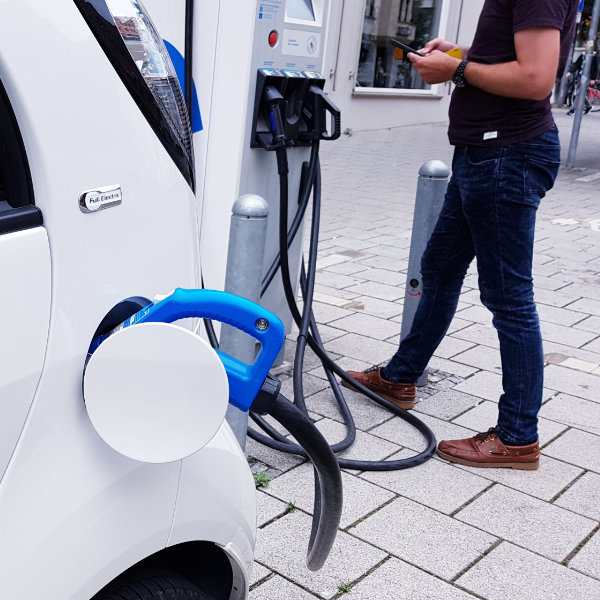
EV charger connector types explained
So, we’ve already touched upon some of the EV connector types on the market; but what’s the difference between them?
Type 1 EV charger connectors
Type 1 connectors are mostly found on older electric vehicle models in the UK, although it currently remains the standard connector over in the US. If your car only has a Type 1 charging port, you’ll still be able to charge it at socketed slow/fast charging points.

Type 1 connector
Type 2 EV charger connectors
Type 2 connectors are the most common EV charger connection type across the UK and Europe. They’ve been required in all public slow/fast chargers in Europe since 2014; and importantly, they feature a locking mechanism to prevent the cable being tampered with while your vehicle is charging.

Type 2 connector
Commando connectors / CEE connectors
There’s also Commando connectors (or CEE connectors, as they’re also known). Some slow/fast charging points still have them, but they’ve been all but phased out in modern EV models.

Commando connectors / CEE connectors
CHAdeMO connectors/ CCS connectors
As for rapid charging, we’ve already mentioned CHAdeMO connectors (aka Charge de Move) and CCS connectors (aka Combined Charging System). The former is designed for 50kW rapid chargers and above, while CCS only works with 100kW and above ultra rapid chargers.

CHAdeMO connectors/ CCS connectors
CCS connectors type 2 connectors
As the Combined Charging System name implies, CCS connectors and sockets feature a ‘combo’ design. The top half is a regular Type 2 connector (or occasionally Type 1) while the bottom half is a rapid DC charger.
This means you can use the same socket on your electric vehicle for both slow/fast charging and rapid/ultra-rapid charging.

CCS / Type 2 Connector
Tesla Type 2 (Supercharger) connectors
Tesla Supercharger stations use either a special Tesla Type 2 connector or a standard CCS connector, with the latter used in more recent Tesla models.
(The regular old Type 2 is also used for certain rapid charging stations, which use AC power instead of DC.)
Tesla Type 2 Connector ( Identicle to standard type 2 with differrent internal technology)
Domestic 3-pin plugs
Oh, and as well as the aforementioned Mode 3 cables – the ones with a universal Type 2 connector at the charging point end – EV owners can also use ‘Mode 2’ cables which plug directly into their home’s mains supply using a standard 3-pin socket for slow charging.
These are handy if you’ve run out of power on the driveway, but they can wreak havoc with your home’s electricity over time.
It’s generally much safer and much more reliable to get a proper socketed charger installed at your home instead.

UK Type G Power Plug - included on mode 2 'charge at home' cables
What’s the summary?
It all sounds pretty complex, doesn’t it?
Don’t worry; if you’re looking to install charging stations at your home or place of business, here’s all you really need to know about EV charger compatibility:
- All electric cars come with the ports and cables to support slow charging at the very least.
- Most EVs also support fast charging, and many also support rapid/ultra-rapid charging too.
- Type 2 connectors are the UK standard for slow/fast charging, and untethered/socketed chargers offer a universal slow/fast charging solution.
- If you’re installing a home charger, a slow or fast Type 2 untethered charger around 7kW will likely be more than enough.
- If you’re installing chargers at your workplace or retail location, a fast 22kW Type 2 untethered charger arguably offers the best balance of cost-effectiveness and charging speed

JC Electrical UK’s experienced electrical engineers can help you join the EV and PHEV revolution, with professional EV charging point installations for your home or business. Visit our EV Chargers page or get in touch on 0208 839 9561 or email info@jcelectric.co.uk for more info!
NICEIC Approved Electricians + Registered Competent Person